

Wednesday, February 25, 2009

Monday, February 23, 2009


Sunday, February 22, 2009
Cultural bathing experience

Ancient Egyptian Bathing Rituals...
For soap Egyptians used swabu (means to clean), a paste containing ash or clay, which was often scented, and could be worked into a lather. This soap was talked about in "The Ebers Medical Papyrus", dating from about 1500 BCE, describes mixing animal and vegetable oils with alkaline salts. The soap-like material was used for treating skin diseases, as well as for washing
Walking barefoot the feet got dusty, which, as the floors of their houses were no different from the ground outside. The richer, or upper class Egyptians had wooden or clay footbaths for washing their feet, usually there were two basins as only one foot could fit in each basin
At Tebtunis public bathhouses have been excavated, the oldest dating to the third century BCE. They had showers, stone basins and a stove to heat the bath water.[3]
While a few bathrooms and tubs have been discovered most Egyptians seemed fine with cleansing through aspersion or by a dip in a canal or the river. They had wash basins and probably filled them with a natron and salt solution from jugs with spouts and used sand as a scouring agent. They washed after rising and both before and after the main meals, but one may assume that their ablutions were mostly perfunctory. As mouth wash they used another solution called bed (bd: natron).
If washing did not help to get rid of body odor sometime the advice of a physician was sought after who had a number of recipes at his disposal:
http://nefertiti.iwebland.com/timelines/topics/cosmetics.htm
Thursday, February 19, 2009


Thursday, February 12, 2009

Saturday, January 31, 2009
Patter Perception II
 Well this is my second attempt at the pattern perception assignment. It is I admit a big improvement from the first one. My pattern started out as a picture of Washington D.C. when the Cherry Blossoms were in full bloom. I just used the mag. lasso tool and masked the part of the bloom that I thought was the pretties. I enhanced the cropped section using the Exposure adjustment. Then I copied and pasted multiple times and created my pattern. Then I inverted a few to add a little a little more interest to the peice.
Friday, January 30, 2009
Arch. Response
A Thoughtful Reflection
There is no denying that we live in a world that depends heavily on computers. It wasn’t long ago that we thought the end of the world was soon to come because of the big Y2K event. So many advances have been made due to the invention of computers and computer aided design software, it’s hard to find flaws. But on the reverse side of that were do humans fit in?
Computer aided design software is highly effective and efficient, and has helped us to make huge leaps in our designs. Numerous design possibilities that 60 years ago would have been thought of as impossible, or time consuming have become a reality due to the computer, and its easy and fast calculations.
As a new designer I am only beginning to see how important computers are to the design process. Scanning a photo into a computer and clicking a few buttons to enhance it is only the beginning of endless possibilities the computer can offer.
On the other side I can’t see myself feeling as emotionally attached to a design that I sat in front of a computer clicking away at, as I do to a design that I have spent countless hours drafting out. Doing it the old fashion way and hand-drafting it out is by far the one time in my design process that I feel the most at ease, because I love to do it, and I’m good at it. But not only in drafting but also in hand rendering, there is just this personal touch that a client can see when you present your ideas. They can relate to the fact that this took you a long time.
As designers it’s hard for us in a time crunch to choose the slow way, by hand, rather than take the easy way out and use a computer. But also as designers I feel like it’s important for us to find that happy medium between computers and the human touch. We must look back to the past before we can move ahead.
There is no denying that we live in a world that depends heavily on computers. It wasn’t long ago that we thought the end of the world was soon to come because of the big Y2K event. So many advances have been made due to the invention of computers and computer aided design software, it’s hard to find flaws. But on the reverse side of that were do humans fit in?
Computer aided design software is highly effective and efficient, and has helped us to make huge leaps in our designs. Numerous design possibilities that 60 years ago would have been thought of as impossible, or time consuming have become a reality due to the computer, and its easy and fast calculations.
As a new designer I am only beginning to see how important computers are to the design process. Scanning a photo into a computer and clicking a few buttons to enhance it is only the beginning of endless possibilities the computer can offer.
On the other side I can’t see myself feeling as emotionally attached to a design that I sat in front of a computer clicking away at, as I do to a design that I have spent countless hours drafting out. Doing it the old fashion way and hand-drafting it out is by far the one time in my design process that I feel the most at ease, because I love to do it, and I’m good at it. But not only in drafting but also in hand rendering, there is just this personal touch that a client can see when you present your ideas. They can relate to the fact that this took you a long time.
As designers it’s hard for us in a time crunch to choose the slow way, by hand, rather than take the easy way out and use a computer. But also as designers I feel like it’s important for us to find that happy medium between computers and the human touch. We must look back to the past before we can move ahead.
Wednesday, January 28, 2009


Tuesday, January 27, 2009
Design Manifesto


A Design Manifesto
"Helping people protect, enhance, and enjoy the places that matter to them."
--National Trust for Historical Presorvation--
"When histoic buildings and neighborhoods are torn down or allowed to deteriorate, a part of our past disappears forever. When that happens, we lose history that helps us know who we are, and we lose opportunities to live and work in the kinds of interesting and attractive surroundings that older buildings can porvide."
--National Trust for Historical Presorvation--
..."see through to the past..."
-design is a process therefore it evolves.-
It is my belief that we as a society of designers are in one continuous design process. Many movements have stemmed out as we have evolved , movements such as bauhaus, art deco, cubism, impressionism, modernism, all of these movements have helped us get to where we are today as designers. This theory is the reason why I believe what I believe. Many designers can talk about being Green and going Green, I think that one of the most effiecent ways of going Green is by helping to restore what is already here. My career goal is to become a historic presorvationist. Its olders building, houses, and places that I draw inspiration from. Its the litte sqeaks in the floor or doors that I find the most interesting. Those peices of character is what draws me into a space. It's almost as if the house is letting me in on a secret, telling me what has happened in it's lifetime.
The idea of seeing into the past is what I protrayed in my artifact. We need to understand and connect to those things that have passed before us to truely be good designers in the future.
Thursday, October 23, 2008
 Charles B. Aycock District
College Park district
 Fisher Park district
David Wharton – Vice Chair of the Historic Preservation Commission
The City of Greensboro has a Historic Preservation Commission that oversees the historic district program and advises the City Council on historic preservation matters. David Wharton, Vice Chair of the HPC and I have been in contact over the last few days about what exactly it is they do for the city. He explained to me that the HPC oversees the three locally-designated historic districts in Greensboro – College Hill, Fisher Park, and Charles B. Aycock. They review, approve/deny applications when owners in these districts want to make changes or additions to their properties. Each change is governed by Greensboro’s historic Preservation Design Guidelines and Manual.
What’s so important about these structures is that each individual one has a story to tell, it’s a living record of the people who lived in and/or used it – the way they lived, their sense of style. Once these structures are lost, they are gone forever: unrecoverable. In this way, the buildings are a living and real connection to Greensboro’s past, and can tell present residents stories about where their city came from.
David Wharton’s job at the HPC impacts the city of Greensboro in many ways. Economical studies have shown that historic districts help neighborhoods retain and increase their property values, and can provide stability to neighborhoods in transition and decline. This is certainly true of all three Greensboro neighborhoods. They were either beginning to decline, or in deep decline when they were designated as historic districts and all have since become active, vital, and stable places to live. These districts are also available for the public at large, either by driving through them or taking the annual walking tours offered by a private group (Preservation Greensboro, Inc). They also provide Greensboro with a sense of place, that is, of being someplace rather than just anyplace. In that way, they help to give Greensboro its distinctive identity.
These districts not only have an impact within the city of Greensboro but also to the design world as a whole. The Greensboro historic districts have functioned as something of a Petri dish for innovative design ideas. Especially, the Charles B. Aycock district that pioneered preservation design by hiring a firm to come up with a neighborhood plan that included a proposal to renovate the 1926 World War Memorial Stadium and integrate its use with the surrounding neighborhood and nearby Farmers’ Curb Market. That plan was submitted in a design competition sponsored by the Congress for the New Urbanism (though it didn’t win). Unfortunately, the plan has never been implemented, but some of its proposals are included in the upcoming transportation bond package.
The City of Greensboro has a Historic Preservation Commission that oversees the historic district program and advises the City Council on historic preservation matters. David Wharton, Vice Chair of the HPC and I have been in contact over the last few days about what exactly it is they do for the city. He explained to me that the HPC oversees the three locally-designated historic districts in Greensboro – College Hill, Fisher Park, and Charles B. Aycock. They review, approve/deny applications when owners in these districts want to make changes or additions to their properties. Each change is governed by Greensboro’s historic Preservation Design Guidelines and Manual.
What’s so important about these structures is that each individual one has a story to tell, it’s a living record of the people who lived in and/or used it – the way they lived, their sense of style. Once these structures are lost, they are gone forever: unrecoverable. In this way, the buildings are a living and real connection to Greensboro’s past, and can tell present residents stories about where their city came from.
David Wharton’s job at the HPC impacts the city of Greensboro in many ways. Economical studies have shown that historic districts help neighborhoods retain and increase their property values, and can provide stability to neighborhoods in transition and decline. This is certainly true of all three Greensboro neighborhoods. They were either beginning to decline, or in deep decline when they were designated as historic districts and all have since become active, vital, and stable places to live. These districts are also available for the public at large, either by driving through them or taking the annual walking tours offered by a private group (Preservation Greensboro, Inc). They also provide Greensboro with a sense of place, that is, of being someplace rather than just anyplace. In that way, they help to give Greensboro its distinctive identity.
These districts not only have an impact within the city of Greensboro but also to the design world as a whole. The Greensboro historic districts have functioned as something of a Petri dish for innovative design ideas. Especially, the Charles B. Aycock district that pioneered preservation design by hiring a firm to come up with a neighborhood plan that included a proposal to renovate the 1926 World War Memorial Stadium and integrate its use with the surrounding neighborhood and nearby Farmers’ Curb Market. That plan was submitted in a design competition sponsored by the Congress for the New Urbanism (though it didn’t win). Unfortunately, the plan has never been implemented, but some of its proposals are included in the upcoming transportation bond package.
Monday, October 13, 2008
Shelter/Bus
 Programatic diagram:
With my Programatic diagram I wanted to use shapes that I felt would go with my concept. So I chose puzzel peices, every peice fits with the next except for the two larger peices which represent the two races in my concept. The two large peices are so close to being able to become one there just missing one thing.
 Longitudinal Section A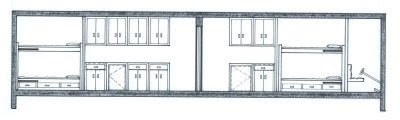
Longitudinal Section B

Cross Section C
 Cross Section D
 Cross Section E
Cross Section F
 Section key
Prejudice
Imagine trying to save someone on the verge of death, but they refuse your help. These individuals are neither depressed nor insane, their prejudice.
Natural disasters cause devastation all over the world, but in 2005, a hurricane that many of us will never forget hit the American coast and destroyed thousands of homes, businesses, and lives. All types of people came together after this horrific disaster to try and help the victims still trapped in Louisiana. As a nation we showed great compassion and care for the victims, but a small group of relief workers seemed to be ostracized during the mission.
A small documentary was made about Muslim victims and relief workers. Ruben Vaughan one of the Islamic relief workers said he experienced two different reactions from non-Muslims. In one instance some of the workers were helping carry supplies to affected areas when people would turn and ask them what they were doing saying, “We don’t need your help you can just take it back.” While others would load up their cars and help the workers on their way. Even such a small thing as wearing a hijab on their head would cause people to turn away from their help.
Prejudice is real and is still ever so present in our society, even in Greensboro. For instance when approaching the GTA bus ride feeling slightly prejudice against the individuals on the bus seemed to come naturally to most people. Scared, nervous, slightly germ phobic, and resentment for having to ride the bus with a bunch strangers seemed to be a common thread among my peers.
Prejudice can also be explained in terms of a force field that drives people apart, similar to two magnets when you have one negative and one positive charge. It seems that no matter how hard you try to just connect the two and create a whole, there’s always that force, that wall, that keeps the from one another.
A concept revolving around prejudice, interrupted into a bus for 4 relief workers, (two of which are of Islamic decent, and two of American decent) whom have two symmetrical sides on the bus. The symmetrical sides are a symbolic representation of the commonality of the four individuals. That although they may have different backgrounds they are all people just the same. The two communal areas for the four individuals are located in the center of the bus where a series of two pocket doors are located which gives the option to open it up as one major room where they can all become a whole. But like the magnetic force, there seems to be a something in the way that keeps the pocket doors seem from opening up completely. Only a small sliver of the adjacent communal area is able to be seen.
As individuals we need to understand that disasters know no prejudice it happens to everyone.
Friday, October 3, 2008
Bus / Shelter - landmark project


Mockery
When looking closely at Weatherspoon Art Museum I noticed that the entire building is made of nothing but horizontal and vertical lines. Ranging from the mortar lines in the brick walls, to the vertical columns located at the corner of Tate and Spring Garden, to the fence running along side the sculpture garden. Inspired by the simplicity of these two elements, I derived my idea.
Not wanting to contrast with the existing environment in which my bus shelter is to be placed, I choose to compliment it by using the same design elements displayed in the Weatherspoon Art Museum. The basics of my bus shelter consist of four verticals lines and two horizontal lines. The four vertical lines are made up of a simplified, elongated version of the existing columns located at the museum. To add interest to the structure the column heights vary. The two horizontal lines are made up of the roof structure and the seating. Coinciding with the mortar lines and the fencing the roof structure is a solid slab of horizontal wood. To answer functional needs, benches have been incorporated with the options of group seating, private seating or even the option of standing along the outskirts.
Inspired by elements displayed in the Weatherspoon Art Museum, I derived an idea of a coherent shelter by using simple lines to create a functional structure for the people of the Greensboro community.
Subscribe to:
Posts (Atom)